A really nice video about the harmless water snakes that call Austin's creeks and streams home. Highly recommend watching this video!
Here's the permalink to the video:
http://www.youtube.com/watch?v=YdFq5Y6zSV4

Showing posts with label reptiles. Show all posts
Showing posts with label reptiles. Show all posts
Wednesday, December 15, 2010

Friday, September 17, 2010
The Reach Makes Baby Turtles

Just found this baby turtle on the Reach last night. Cutest thing ever. I rescued him to the yard because the mowers were coming today. But he'll make a return. It's so great to know that turtles are there, mating, laying eggs, reproducing and then growing up and old. Ecology!
Sunday, August 15, 2010
The Snakes Among Us
Snakes: for some people, the reptiles constitute one of the joys of living near a Texas stream. For others, they are hair raising, slithering creatures that must be dealt with using a shovel with a long handle. Off with their heads!
Personally, I'm one of the former. I love seeing snakes around the Reach and the neighborhood. That doesn't mean that they don't give me the heebie-jeebies when I come across one. We must be pre-programmed genetically to give fright at their sight.
Knowing more about snakes is one way to fear them less. We should be particularly grateful that we aren't likely to find any of the poisonous snakes native to our area at the Reach. Everything's possible of course, but cottonmouths tend to like shallow, stagnant stretches of water that we don't have. Think big pools and ponds. Rattlesnakes aren't likely to find their way past all the roads and freeways, and they generally prefer rockier areas. Coral snakes are very rare.
Around the Reach, we have two very common snakes, both non-poisonous. There's the blotched water snake and the Texas rate snake.
All snakes provide good food for the hawks and owls, and are predators of frogs and rodents. Just one part of the important food chain here.
The Blotched Water Snake

These snakes are quite common down in the stream, though during drought they can be found wandering about on land. When scared, they can flatten their heads, which makes them look a bit more like the cottonmouth. One way to tell the difference is that cottonmouths float across the surface when swimming. When the water snakes swim, only their head is above water.
The Texas Rat Snake

These snakes are great consumers of all our nastiest little rodents, but they love chicken eggs too (just ask the Choates). They can get large (4 to 6 feet long) and climb vertical surfaces. That means they can be found lounging vertically on your house wall. And of course, craziness will then ensue! Mostly, we see the young snakes around the hood, and often they are found squashed in the road, but larger ones are about. These snakes can be aggressive when cornered, they may even hiss and bite. It'll hurt, but remember: no poison. Best just to give them some respect as they move on their way to find a meal.
All of this information and these photos come from the Austin Area Snake Identification Pages.
Personally, I'm one of the former. I love seeing snakes around the Reach and the neighborhood. That doesn't mean that they don't give me the heebie-jeebies when I come across one. We must be pre-programmed genetically to give fright at their sight.
Knowing more about snakes is one way to fear them less. We should be particularly grateful that we aren't likely to find any of the poisonous snakes native to our area at the Reach. Everything's possible of course, but cottonmouths tend to like shallow, stagnant stretches of water that we don't have. Think big pools and ponds. Rattlesnakes aren't likely to find their way past all the roads and freeways, and they generally prefer rockier areas. Coral snakes are very rare.
Around the Reach, we have two very common snakes, both non-poisonous. There's the blotched water snake and the Texas rate snake.
All snakes provide good food for the hawks and owls, and are predators of frogs and rodents. Just one part of the important food chain here.
The Blotched Water Snake

These snakes are quite common down in the stream, though during drought they can be found wandering about on land. When scared, they can flatten their heads, which makes them look a bit more like the cottonmouth. One way to tell the difference is that cottonmouths float across the surface when swimming. When the water snakes swim, only their head is above water.
The Texas Rat Snake

These snakes are great consumers of all our nastiest little rodents, but they love chicken eggs too (just ask the Choates). They can get large (4 to 6 feet long) and climb vertical surfaces. That means they can be found lounging vertically on your house wall. And of course, craziness will then ensue! Mostly, we see the young snakes around the hood, and often they are found squashed in the road, but larger ones are about. These snakes can be aggressive when cornered, they may even hiss and bite. It'll hurt, but remember: no poison. Best just to give them some respect as they move on their way to find a meal.
All of this information and these photos come from the Austin Area Snake Identification Pages.
Friday, March 28, 2008
Poor Blotchy
 People, please, pretty please THINK about it--do some research for heaven's sake--before you kill a snake in the creek!!
This morning, I was walking around the Reach and saw a beautiful blotched water snake hunting for critters in the Bathtub. It's a native, non-poisonous snake that's often confused with water moccasins and cottonmouths. Chances are EXTREMELY LOW that we would ever, ever have a moccasin on the Reach. (That doesn't mean we shouldn't take precautions when encountering a snake, it just means we should THINK before we kill.)
Poor, poor Blotchy the Water Snake. Happily nibbling on our pesty little rats, mice and mega-roaches. Now succumbed to the wanton power of human insecurities, chopped into bits by the (damned) Easter Seals (who meant well, but still).
Thursday, May 31, 2007
3 Snappers
I saw THREE snapping turtles on the reach yesterday morning. I watched one of them struggle to climb over the cement shelf that creates "Cherrywood Falls." It succeeded, after some wince inducing slips. The other two were in the Bathtub. Cool.
Thursday, May 17, 2007
All along the Bathtub
 The latest and greatest wildlife report:
Spiderworts--with a name that evokes witchcraft and cauldrons boiling--are shade loving, early spring blooming plants that are on their way out. The flowers bloom once, but during bloom time the plant produces so many flowers that it remains in flower day after day. Now, I only see the drooping seed heads, which means that soon, the plants will go dormant for the summer.
Some kind of morning glory is starting to make an appearance. (I tried to snap a photo this morning, but my surprisingly unsustainable digital camera sucks through batteries like an aphid on cocaine. So the photo here is snagged from the Wildflower Center.)
Sensitive briar, coreopsis, Mexican hat and Indian blanket have all made a come back since the last mowing. (But so has the Johnson grass, whose pink blooming stalks are shooting up around the banks.)
A came across a snake in the Bathtub this morning. (That combination of words is probably enough to strike fear in many of you. Don't even think about making it into a bad movie.)
Snakes are frighteningly beautiful and always slightly startling. The fear response is clearly an evolutionarily adapted response, and rightly so, especially here in Texas, where there are quite a few snakes that you don't want to get into a tangle with. The Reach is unlikely to have any poisonous snakes, but it's always best to use caution. The one I saw this morning was clearly non-poisonous, and beautifully undulating through the deep waters of the Tub.

Speaking of the deep-water Bathtub, it supports quite a healthy little ecosystem. Dave W. reported a large owl there just the other day (could be a Great-horned owl, which I also saw at the Reach last fall). The snapping turtle(s) also call the Tub home, and in fact, I saw two mating there last summer. It's also where we've recently seen Great Blue Herons taking a pit-stop during migration and wood ducks. By the way, if you're looking for the Yellow-crowned Night Heron, it usually likes to hunt in more secluded areas with overgrowth down the creek.
Wouldn't it be cool to stumble upon a fish being eaten by a snake just before the snake is grabbed by one of our hawks or owls? Nature rocks.
Friday, April 20, 2007
Sitings: Apr 20
 Despite the fact that most of the wildflowers were mown to the ground, there are still some resilient evening primroses blooming along the edge of the Reach (in the area where the Easter Seals folks left the vegetation taller). This morning, I still saw about 4-5 white-lined hawkmoths (at minimum) flitting around the banks. Whew!
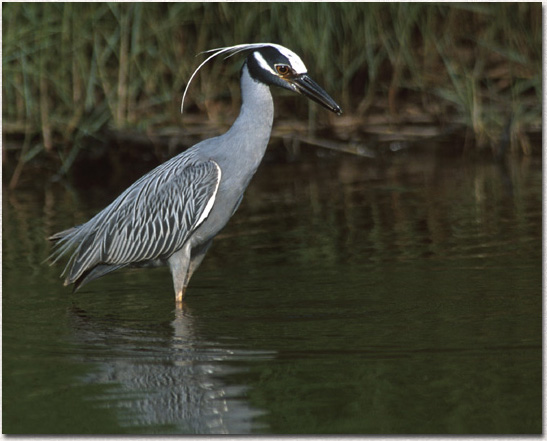
Also ran into a yellow-crowned night heron perched on the mid-reach pipe just above a lurking snapping turtle. It swoooshed away and was later heard squawking from the tips of the branches of large elm tree on the south side by the picnic table. (Note, the photo above is not on the Reach...I only wish I could take such photos!)
Some fish are beginning to create breeding territories in The Bathtub - you can see the territories as circles along the creek bottom that are devoid of debris. The males clear these out, defend them, and await for females to choose their circle to lay eggs (well, that's generally how it goes). I don't know which species of fish this is, but I think it may be a type of sunfish.
Subscribe to:
Posts (Atom)